


 Cart
Cart
 sales@molnova.com


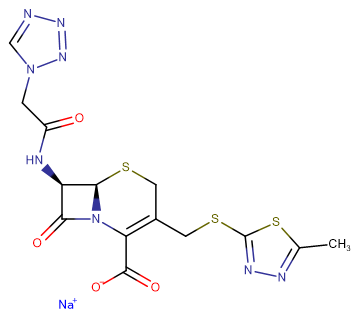
Cefazolin sodium salt
CAS No. 27164-46-1
Cefazolin sodium salt( NSC 291561 | SKF 41558 )
Catalog No. M13830 CAS No. 27164-46-1
Cefazolin sodium is a first-generation cephalosporin antibiotic, useful for the treatment of a number of bacterial infections.
Purity : >98% (HPLC)
 COA
Datasheet
HNMR
HPLC
MSDS
Handing Instructions
COA
Datasheet
HNMR
HPLC
MSDS
Handing Instructions
| Size | Price / USD | Stock | Quantity |
| 50MG | 42 | In Stock |


|
| 100MG | 56 | In Stock |
|
| 500MG | 113 | In Stock |
|
| 1G | Get Quote | In Stock |
|
Biological Information
-
Product NameCefazolin sodium salt
-
NoteResearch use only, not for human use.
-
Brief DescriptionCefazolin sodium is a first-generation cephalosporin antibiotic, useful for the treatment of a number of bacterial infections.
-
DescriptionCefazolin sodium is a first-generation cephalosporin antibiotic, useful for the treatment of a number of bacterial infections.(In Vitro):Cefazolin sodium (0-300 μg/ml; 6 or 24 h) has a direct anti-inflammatory effect on C8-B4 cells stimulated by lipopolysaccharide.Cefazolin sodium (0-400 μM; 72 h) treatment inhibits IL-2, IL-4 and IL-15-induced cell proliferation.Cefazolin sodium (0-400 μM; 30 min) treatment inhibits IL-2, IL-4, IL-15 and IL-21-stimulated JAK3 phosphorylation.(In Vivo):Cefazolin sodium (Subcutaneous injection; 300-500 mg/kg; once daily; 5 d) treatment improves learning and memory in mice after surgery.
-
In VitroCefazolin sodium (0-300 μg/ml; 6 or 24 h) has a direct anti-inflammatory effect on C8-B4 cells stimulated by lipopolysaccharide.Cefazolin sodium (0-400 μM; 72 h) treatment inhibits IL-2, IL-4 and IL-15-induced cell proliferation.Cefazolin sodium (0-400 μM; 30 min) treatment inhibits IL-2, IL-4, IL-15 and IL-21-stimulated JAK3 phosphorylation.Cell Viability Assay Cell Line:C8-B4 cells Concentration:0, 50, 100, 150, 200, 250, or 300 μg/ml Incubation Time:6 or 24 hours Result:Inhibited the increase of IL-1β at all doses, but inhibited the increase of IL-6 only at 200 μg/ml.Cell Proliferation Assay Cell Line:PBMC, and TF-1 cells Concentration:0, 100, 200, and 400 μM Incubation Time:72 hours Result:Reduced IL-2, IL-4 and IL-15-induced cell proliferation, suggested that Cefazolin interferes not only with IL-15Rα, but also with IL-2/IL-15Rβ and/or γc.Cell Viability Assay Cell Line:PBMC, NK-92, and TF-1 cells Concentration:0, 100, 200, and 400 μMIncubation Time:30 min Result:Diminished the phosphorylation of JAK3 in response to the cytokine treatment, concluded suppressing signal transduction by γc receptors.
-
In VivoCefazolin sodium (Subcutaneous injection; 300-500 mg/kg; once daily; 5 d) treatment improves learning and memory in mice after surgery. Animal Model:6- to 8-week-old male CD-1 mice underwent clinical exploratory laparotomy Dosage:300-500 mg/kg Administration:Subcutaneous injection; 300-500 mg/kg; once daily; 5 days Result:Attenuated learning and memory dysfunction induced by the surgery.
-
SynonymsNSC 291561 | SKF 41558
-
PathwayGPCR/G Protein
-
TargetAntibacterial
-
RecptorPBPs| Peptidoglycan synthase| PON
-
Research AreaInfection
-
Indication——
Chemical Information
-
CAS Number27164-46-1
-
Formula Weight476.48
-
Molecular FormulaC14H13N8NaO4S3
-
Purity>98% (HPLC)
-
SolubilityDMSO: 10 mM
-
SMILESCC1=NN=C(S1)SCC2=C(N3[C@@H]([C@@H](C3=O)NC(=O)CN4C=NN=N4)SC2)C(=O)[O-].[Na+]
-
Chemical Name——
Shipping & Storage Information
-
Storage(-20℃)
-
ShippingWith Ice Pack
-
Stability≥ 2 years
Reference
1.Truesdell SE, et al. J Antimicrob ChemOthers. 1989 Apr;23 Suppl D:13-9.
molnova catalog



related products
-
(-)-Corynoxidine
(-)-Corynoxidine is an AChE inhibitor derived from tubers of Stephania succifera. Corynoxidine exhibits antibacterial activities against Staphylococcus aureus and methicillin-resistant Staphylococcus aureus strains in different degrees.
-
Dalbavancin
Dalbavancin(MDL-63397, BI-397) is a novel second-generation lipoglycopeptide antibiotic that exerts its bactericidal effect by disrupting cell wall biosynthesis.
-
Picloxydine
Picloxydine has antiplaque and antibacterial activity. Picloxydine has a destructive effect on the bacterial cell wall and plasma membrane, which leads to cell lysis and release of intracellular components.
